15x20x4 Air Filters: How Often to Change in a Dusty Home?
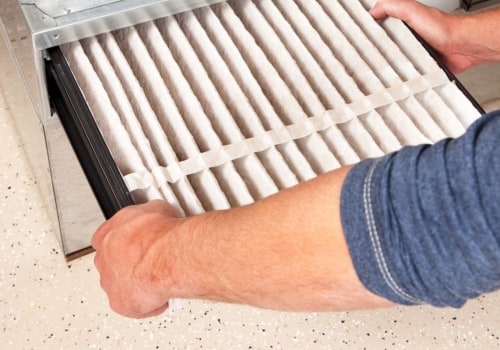
At Filterbuy, the filters that come back from dusty homes tell a clear story, and the 4-inch ones tell it best. The pleats return packed with a gray felt of dust, heaviest right where the air rushed through. Every bit of that is dust your family never breathed, and your blower never had to fight. Here is the problem we keep running into, though. Because a 15x20x4 holds far more than a thin one-inch panel, people leave it in for half a year and assume it is handled. In a dusty home, that habit slowly starves your airflow and lets dirtier air drift back into the rooms you work hard to keep clean. The good news is that the fix is simple once you know your real change interval.
TL;DR Quick Answers
15x20x4 Air Filters
A 15x20x4 is a 4-inch deep-pleat filter, and it actually measures about 14.5 by 19.5 by 3.63 inches. In an average home, change it about every 90 days. In a dusty one, swap it every 6 to 8 weeks and check it monthly. That extra depth is what lets a MERV 13 trap fine, invisible dust without choking the air your system moves.
Top 5 Takeaways
15x20x4 is just the label. The real filter measures about 14.5 by 19.5 by 3.63 inches.
Average home: every 90 days. Dusty home: every 6 to 8 weeks.
Check it monthly and change it when the pleats go gray, not when the calendar says to.
MERV 13 is what the EPA points to, and the 4-inch depth keeps it from starving your airflow.
Keep a 6-pack by the return so a fresh one is always within arm’s reach.
What Size Is A 15x20x4 Air Filter, Really?
Here is the part almost nobody tells you. A filter sold as 15x20x4 does not actually measure 15 by 20 by 4 inches. That is the nominal size, the rounded number you shop by. The real, trimmed size of most 15x20x4 air filters is about 14.5 by 19.5 by 3.63 inches, and some makers cut theirs to 14.5 by 19.5 by 3.75. We build them a hair under on purpose, so the filter slides into the cabinet clean instead of forcing or bending.
Every air filter does one thing. It pulls particles out of the air before they reach your coil, your blower, and your lungs. A 15x20x4 does it with a 4-inch-deep wall of pleats, which holds far more dust than a flat one-inch panel ever could.
Two sizing details trip people up:
Measure the slot, then round up. If the opening reads 14.5 by 19.5 by 3.63, your nominal size is 15x20x4.
A 15x20x4 is not a 16x20x4. Same 4-inch depth, but the faces are an inch apart. Match the nominal size of your cabinet.
How Often Should You Change A 15x20x4 Filter In A Dusty House?
In a dusty house, change 15x20x4 air filters every 6 to 8 weeks. Plenty of 4-inch filters carry a 90-day rating, and the federal guidance sits right in that range. The EPA tells homeowners to expect a 60-to-90-day life and to swap sooner when a filter comes out heavily soiled. The Department of Energy is blunter for the cooling season. Clean or replace every month or two, and more often if you have pets or live with steady dust.
A few things speed up the clog:
Heavy household dust, sanding, or a remodel in progress
Pets shedding dander and hair
Unpaved roads, desert air, or farmland nearby
Wildfire-smoke season
A system that runs close to nonstop
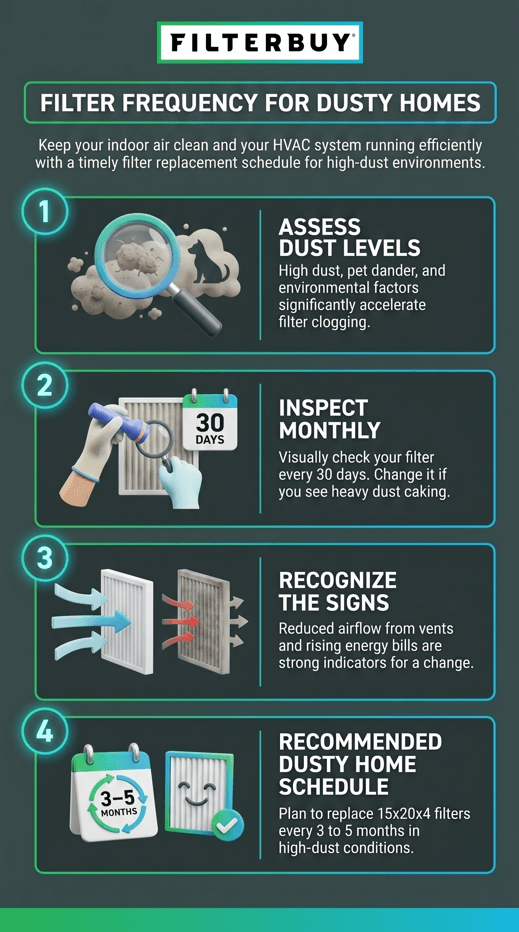
Our rule for dusty homes is simple. Check it monthly, hold it up to a light, and change it the moment the pleats look loaded. Do not wait for a date on the calendar to tell you what your eyes already can.
Signs Your 15x20x4 Filter Is Overdue
This is where the invisible turns visible. Your filter is the one place in the house where all that floating dust collects into something you can actually see and hold. Watch for a few tells:
Weaker air is pushing out of the vents
The system is running longer to hit the same temperature
A gray, matted film across the pleats, easy to spot next to a white sheet of paper
Dust resettling on furniture not long after you have cleaned
Allergy or congestion symptoms are ticking up indoors
Spot any one of these, and your filter has crossed over from helping your system to dragging it down.
MERV 8, MERV 11, Or MERV 13 For A Dusty Home?
For most dusty homes, treat MERV 11 as your floor and MERV 13 as the upgrade worth making the moment your system can handle it. The EPA recommends MERV 13, or as high as your equipment will take, for the cleanest air indoors.
Here is what each step up buys you:
MERV 8 catches the bigger stuff like dust, lint, and pollen, and it keeps your equipment cleaner.
MERV 11 adds finer dust, pet dander, and mold spores.
MERV 13 reaches down to sub-micron particles, smoke included, which is why public-health agencies keep pointing to it.
Now, with the question we hear more than any other. Does MERV 13 restrict airflow? In a 4-inch filter, a lot less than people fear. Those deep pleats pack several times the surface area of a one-inch panel, so the same MERV 13 spreads the air across more material, and the pressure drop stays low. We walk through that same depth-versus-airflow math for another deep size in our guide to why 18x24x2 filters deliver better air, savings, and comfort. There is one honest caveat, though. Your blower still has to be rated for the filter, so give an older or undersized system a quick check before you jump to MERV 13.
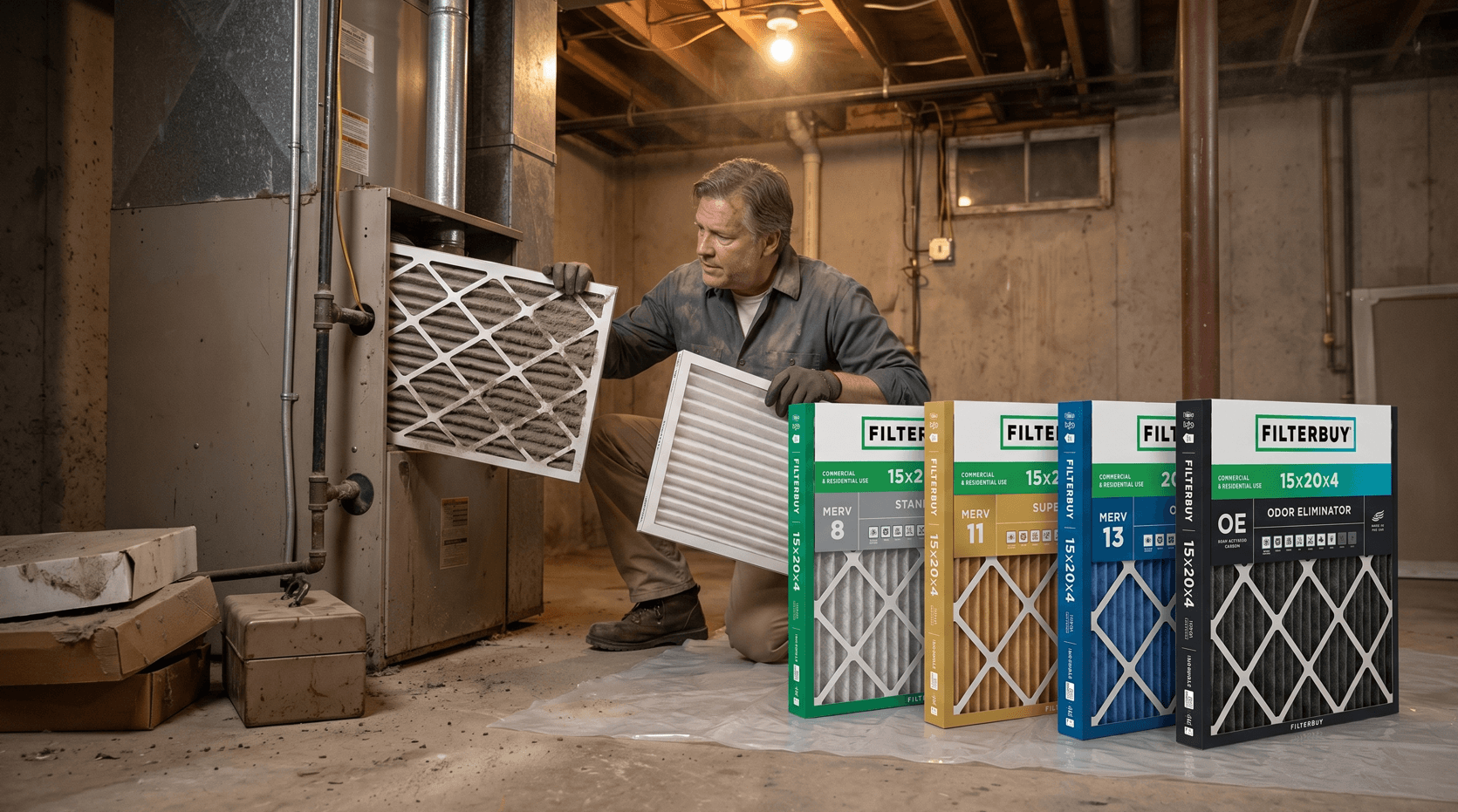
“After manufacturing filters for over a decade and serving more than two million households, we’ve learned that in a dusty home, the filter knows it is full long before the calendar does. A 4-inch 15x20x4 gives you real depth and capacity, but in a dust-heavy house, I still tell people to eyeball the pleats every month and trust what they see.”
Essential Resources On 15x20x4 Air Filters
See Which MERV Rating The EPA Recommends For Your Home
The EPA’s consumer guide shows you how to pick a furnace or HVAC filter and why it steers homeowners toward MERV 13. It also backs up that 60-to-90-day replacement window.
Source: EPA — Guide to Air Cleaners in the Home
Understand Why Deep Filters Ease The Strain On Your System
This Department of Energy Building America guide explains how higher-MERV media changes static pressure, and why your duct and filter-slot sizing matter as much as the rating.
Source: Building America Solution Center — High-MERV Filters
Get A Health Authority’s Take On Filter Upgrades
The American Lung Association recommends moving up to MERV 13 or higher and changing filters about every two months, with a simple white-paper test for spotting a dirty one.
Source: American Lung Association — Air Cleaning
Learn The Right Way To Check And Replace Your Filter
ENERGY STAR walks you through finding the filter, checking it monthly, and explaining why a clogged one makes your system work harder and fail sooner.
Source: ENERGY STAR — Keep Your HVAC System Working Efficiently
Follow The CDC’s Cleaner-Air Steps At Home
The CDC calls for pleated filters and a roughly three-month change interval as part of keeping indoor air cleaner, especially when respiratory viruses are going around.
Source: CDC — Taking Steps for Cleaner Air
Know When Smoke Or Dust Means Changing Your Filter Sooner
AirNow, run by the EPA, posts your local Air Quality Index on a 0-to-500 scale. When wildfire smoke or heavy dust drives that number up, take it as your cue to check and swap a 15x20x4 early.
Source: AirNow — Air Quality Index Basics
Find Filters Certified For Allergy And Asthma Households
The Asthma and Allergy Foundation of America runs an independent program that flags filters proven to cut allergens, which helps a lot if dust sets off symptoms at your house.
Source: AAFA — Certified Asthma & Allergy Friendly Program
Supporting Statistics
The Department of Energy says to clean or replace your filter every month or two through cooling season, and more often in dusty conditions or with pets. In a dust-heavy home, plan on the “more often” end of that range.
Source: U.S. Department of Energy — Air Conditioner Maintenance
Peer-reviewed guidance from the American Academy of Allergy, Asthma & Immunology sets a three-month change interval for normal residential use and notes that 2-to-5-inch filters hold more dust before they choke. A 4-inch 15x20x4 lands right in that higher-capacity range.
Source: National Library of Medicine — Air Filters and Air Cleaners Rostrum
Under ANSI/ASHRAE Standard 52.2, the test method behind every MERV number, filters earn a grade from MERV 1 to MERV 16 based on how well they pull particles as small as 0.3 microns out of the air. A 15x20x4 rated MERV 13 is measured on that same scale, so its number means the same thing brand to brand.
Source: ASHRAE — Standard 52.2 Method of Testing
Final Thoughts And Opinion
A 4-inch 15x20x4 is one of the best filters you can put in a dusty house. Its greatest strength, all that dust-holding capacity, is also where people get tripped up. Because it outlasts a one-inch filter, folks treat it like it never needs a second thought, and that is exactly how a great filter ends up choking a healthy system.
Here is our honest take after years of pulling these out of dusty homes:
A MERV 13 you actually change every 6 to 8 weeks beats a MERV 8 you forget about for a year.
Trust your eyes first. The calendar is just a backup.
Buy a 6-pack, stash it by the return, and let that gray film be your reminder.
Frequently Asked Questions
Q: How Often Should I Change A 15x20x4 Air Filter In A Dusty Home?
A: Every 6 to 8 weeks in dusty conditions, against the roughly 90-day baseline for an average home. Check it monthly and change it once the pleats go gray.
Q: What Is The Actual Size Of A 15x20x4 Air Filter?
A: Right around 14.5 by 19.5 by 3.63 inches. Some makers cut theirs to 14.5 by 19.5 by 3.75. The 15x20x4 on the box is the rounded nominal size you shop by.
Q: Does an MERV 13 15x20x4 Filter Restrict Airflow?
A: Far less than a one-inch MERV 13. The 4-inch depth spreads air across a much larger pleated surface, so the pressure drop stays low. Just confirm your blower is rated for it first.
Q: What Is The Best MERV Rating For A Home?
A: Public-health agencies point to MERV 13, or as high as your system can take. MERV 11 makes a solid default for most dusty homes.
Q: Can I Use A 16x20x4 Filter Instead Of A 15x20x4?
A: No. They share the 4-inch depth, but the faces are an inch off. Measure your slot and match the nominal size.
Q: Are 15x20x4 Filters Sold In 6-Packs Or In Bulk?
A: Yes. Multi-packs and bulk options are easy to find, and they make sense for dusty homes that go through filters faster. Made-in-USA pleated options are out there, too.
Keep Your Dusty House Breathing Clean
Match a 15x20x4 MERV 13 to your system, put a monthly look at the pleats on your list, and keep a fresh 6-pack by the return so a clogged filter is never your only option. Do that, and you stay the one protecting your family’s air, your home, and the HVAC system you would rather not replace early.
Learn more about HVAC Care from one of our HVAC solutions branches…
Filterbuy HVAC Solutions - Miami FL - Air Conditioning Service
1300 S Miami Ave Apt 4806 Miami FL 33130
(305) 306-5027
https://maps.app.goo.gl/Ci1vrL596LhvXKU79